
Stage 1: Collection
Continuous aspiration from the surgical field, real-time volume monitoring. Integrated anticoagulation in BloodSaver enables later processing.

Our BloodSaver technology revolutionizes intraoperative blood management. Worldwide, we are setting new standards for patient safety and surgical efficiency.
BloodSaver explained in detail for:
Previously, wound blood aspirated during operations ended up in unsterile suction bags and was disposed of after the operation. With BloodSaver, the wound blood is collected in a sterile container pre-treated with heparin or sodium citrate and can be retransfused to the patient at any time using a CellSaver. The product is designed to be compatible with existing hospital equipment and can be used without additional investments. The connections are compatible with all standard CellSavers. More products to follow…
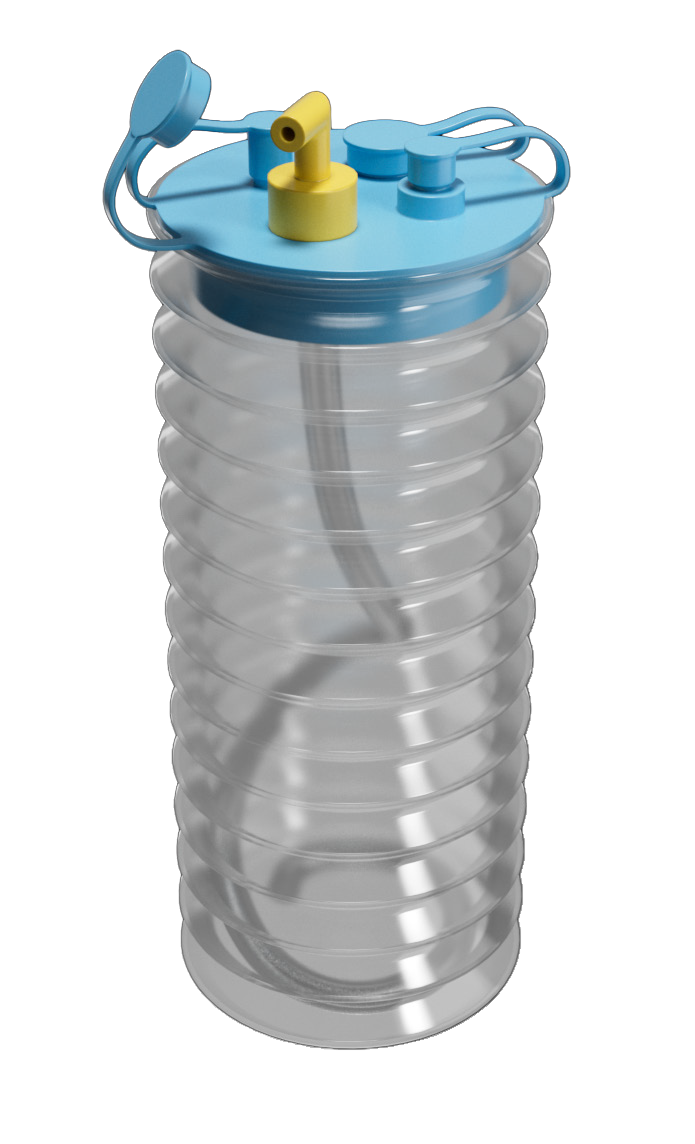
BloodSaver addresses a central problem in surgical practice: avoidable allogeneic blood transfusions with all their risks and costs. Through intraoperative recovery of wound blood, the need for foreign donor blood can be largely eliminated. This not only improves supply security but also patient recovery – faster, safer, more efficient. Fewer transfusions mean fewer complications, shorter hospitalization periods, and thus lower costs for clinics and health insurance companies. Our solutions are aimed at interdisciplinary surgical teams, particularly in surgery, anesthesiology, and hematology. Swiss MedTech Innovations stands for a new generation of medical technology – developed in Switzerland, with a focus on real clinical added value.
Continuous aspiration from the surgical field, real-time volume monitoring. Integrated anticoagulation in BloodSaver enables later processing.
Processing possible at any time through a special connection that is connected to a mechanical autotransfusion device.
Sterility assurance through a closed system. Immediate availability for retransfusion after regular processing using an autotransfusion device.
BloodSaver should and can be used in every operation. Important for retransfusion: Using mechanical autotransfusion, taking into account the same contraindications as with mechanical autotransfusion.
When bleeding is greater than expected, BloodSaver is always ready through a connection and the existing conditions for mechanical autotransfusion. Unexpected blood loss, low Hb value and/or high bleeding risk, specific antibodies/rare blood group, rejection of allogeneic blood products (e.g., Jehovah's Witnesses, but as an individual conscience decision).
When bleeding is greater than expected and because it can only be retransfused through mechanical autotransfusion, the same contraindications apply as with mechanical autotransfusion: bacterial contamination of the wound/surgical area, contamination with feces or pus, tumor surgery (conditional), acute systemic infections (e.g., sepsis), simultaneous use of disinfecting irrigation solutions in the surgical area (e.g., Lavasept, Betaisodona, Betaseptic …), aspiration of amniotic fluid or gastric juice (proteolytic enzymes of these fluids could lead to coagulation disorders), aspiration of antibiotics that are not approved for intravenous use (in orthopedic operations from cement additives; risk of serious reactions).
Since there are different manufacturers of mechanical autotransfusion, some use heparin, some use citrate, there are therefore two variants of BloodSaver: BloodSaver with Heparin and BloodSaver with Citrate.